Book a demo

Language

Try the training Book a demo

Turn expert know-how into AI-guided operator training.

We use documentation, walkthroughs, and input from your expert to generate operational scenarios and training environments in 3D, videos, and learning guides.

  • No connection to live equipment
  • Your expert approves every course
  • Set up with local models if required

See what the course covers and how it connects.

The OTTO knowledge map: units of the course connected to the concepts they teach.
Our AI harness drafts from your sources the units, concepts and how they depend on each other.

How it works

Start with what you know

Bring your notes, documents and screenshots, plus a 45-minute walkthrough with your lead engineer. No polished manuals needed.

Your materialBatch reactor line · demo course

  • Wiki page
  • Procedure (PDF)
  • P&ID
  • 12 HMI screenshots
  • Checklist
  • Walkthrough recording, 45 min

6 sourcesReady for the agents
OTTO builds the course

OTTO turns your material into a course, connecting the key concepts and flagging anything that needs your expert’s attention.

The knowledge map of the demo course: three unit nodes linked to eight concept nodes, with dashed lines for prerequisites.

Your expert reviews it

Your lead engineer reviews the course, adds what’s missing and approves it before anyone learns from it.

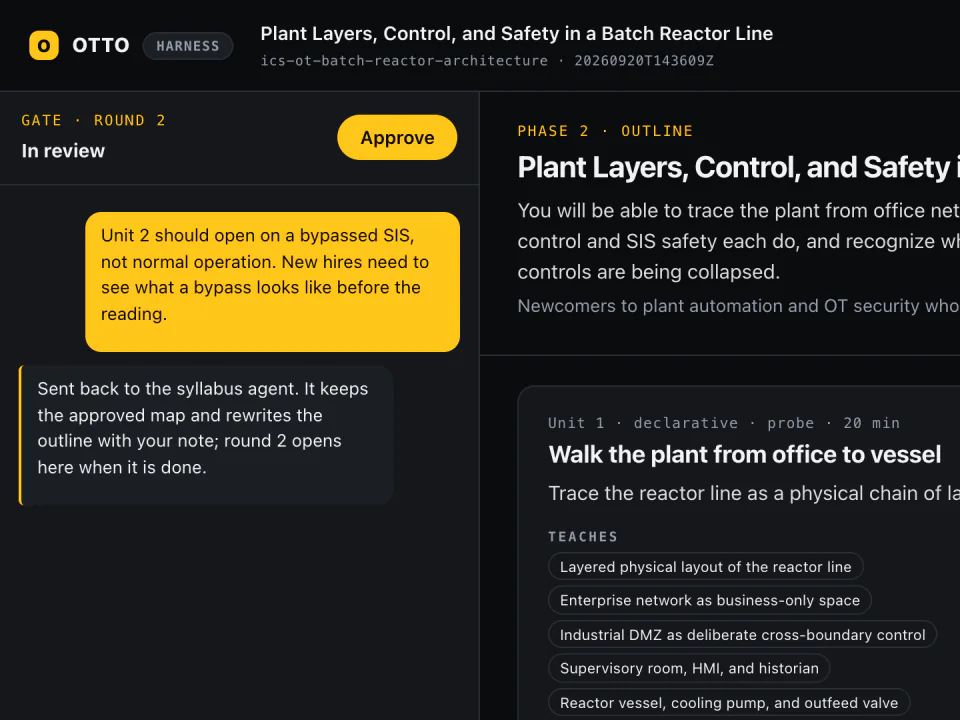
The expert gate in review, round 2: the expert’s note asks for Unit 2 to open on a bypassed SIS, and the harness confirms it sent the outline back to the syllabus agent.

Your operators learn

Operators explore your system, work through realistic scenarios and explain their reasoning with guidance from OTTO.

A 3D walkthrough stop in the supervisory room: the operator console, the data recorder rack, and a panel that reads ‘Operators can ask, not directly act’.

Learn by putting knowledge into practice

ScenarioWalkthroughGuidesPractice

Put it into practice

The cooling pump needs to start earlier during normal operation. Which part of the system would you review first?

Best starting point

That’s the best starting point. The PLC controls when the pump starts during normal operation. What would you check before deciding a change is needed?

Next: explain your reasoningContinue

  • Start with a real situationEach unit begins with a question operators could face on the job.
  • Consider the alternativesWork through choices that are easy to confuse and learn what makes them different.
  • Understand the reasoningOTTO helps you understand why an answer fits and where it falls short.
  • Learn through practiceExplore the system, use the guides and put what you learn into practice.
  • Get feedback as you goSee why your choice works or what you need to reconsider.
  • Explain it in your own wordsShow your understanding by explaining it as you would to a colleague.

Try a lesson with OTTO

Explore a fictional plant, work through a scenario and get feedback on your reasoning.

Try the training

Built for how you deliver

Equipment manufacturers

You bring

Your product documentation, existing training material and a walkthrough with your lead engineer.

You get

Expert-reviewed training for the people who install, operate and troubleshoot your equipment.

Train your own field team, then deliver the training with your equipment.

System integrators and EPCs

You bring

System diagrams, commissioning notes and a walkthrough with the engineer who knows the installation.

You get

Training built around the system you delivered, ready to adapt for the next site.

Make operator training part of every rollout.

Plant and vessel teams

You bring

Your equipment documentation, operating procedures and the questions new crew members ask.

You get

Guided practice on your systems and procedures, reviewed by your expert.

Help each new crew learn from the experience of the last.

Your technology scales. Your training should too.

Every new crew needs the knowledge your experienced engineers carry. Passing it on through calls, site visits and scattered documents keeps those engineers tied to every handover.

Failure mode What happens in the field What it costs you

Inconsistent training

Every operator learns a different way.

Manuals cover part of the job. The rest passes by word of mouth, leaving each crew with a different understanding.

What it costs youRepeated mistakes and inconsistent work.

Limited expert time

Your best engineers keep teaching the same things.

Each new crew or site needs another walkthrough, pulling experienced engineers away from the next project.

What it costs youLess time for engineering and delivery.

Data restrictions

Your knowledge can’t go into just any AI tool.

Client contracts can restrict where drawings, procedures and project information are processed.

What it costs youFewer options for turning existing knowledge into training.

Built for strict industrial contracts.

Your contracts set the boundaries. We work with you to define what material is used and where it’s processed.

The content and training are yours to keep.

No client project data required
Start with your own product documentation and generic equipment examples, without sharing confidential client drawings or recordings.
Set up with local models if required
We agree on the hosting setup for your pilot, including local models when your data requirements call for them.
No connection to live equipment
OTTO is a separate training environment. It doesn’t read from or control your live plant or vessel systems.
Your expert approves every course
Your expert reviews the training, corrects what needs changing and approves it before operators begin.

See what OTTO can do with your knowledge

Start with one workflow. Turn your expert’s knowledge into training, then put it to the test with your operators.

  1. CaptureShare your existing material and walk us through the workflow with your lead engineer.
  2. ReviewYour expert reviews the training OTTO creates, corrects what needs changing and approves it for your operators.
  3. PracticeA few operators complete the training. Together, we review their understanding and identify what needs improving.

Request a pilot estimate

Equipment manufacturer or system integrator

Opens an email draft with your answers. Send it to discuss your pilot’s scope and cost.

How the course gets built

Company knowledge goes to the agentic harness, which drafts a syllabus for a human expert. The expert’s feedback returns to the harness until the course is approved, then learners play it in OTTO.

Company knowledge

Wikis, manuals, procedures

Knowledge

Agentic harness

Agents build the course

Draft syllabus
Feedback

Human expert

Reviews and steers

Course

OTTO

Learners play the course in the browser

Try it as the expert

Knowledge map

The OTTO knowledge map: units of the course connected to the concepts they teach.

1 / 4

Start in a situation

The scenario room: the reactor line laid out from the office, through the boundary and the operators, to the control cabinets and the process floor.
Sample room · fictional batch reactor line · swipe to look around